
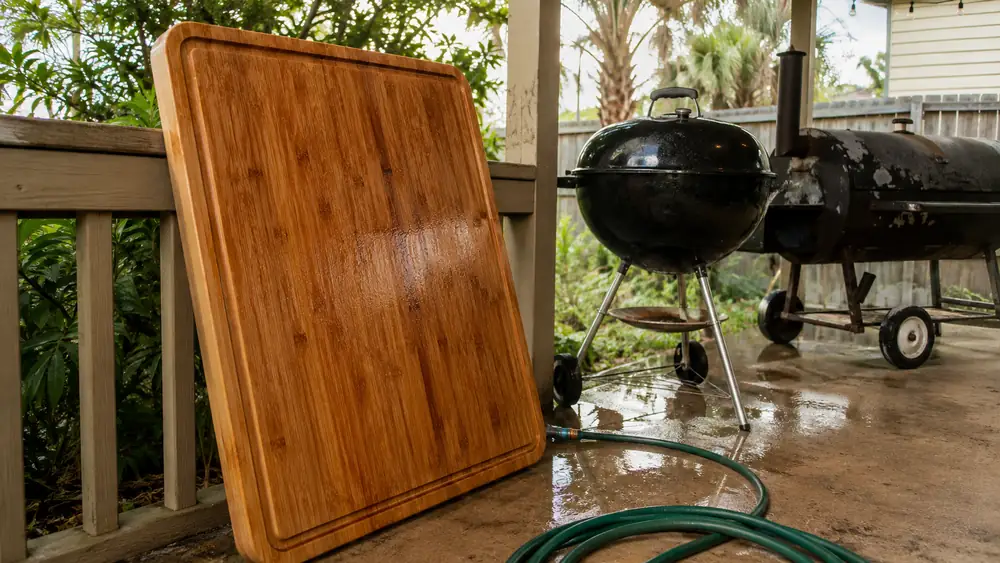
Hollis leaned over the fence between our yards a couple weekends ago while I was hosing down the Greener Chef board after a crawfish boil, and asked me the question everyone asks before they spend real money on a cutting board this size: is it actually worth it. I gave him the honest answer, which is longer and more complicated than the star rating on Amazon would have you believe. Owning this board for close to two years has taught me things about big wood boards that nobody put in the product description, and a few of them changed how I use mine.
I've already written about the day I bought it and what almost two full years of Sunday briskets and holiday turkeys looks like. This one is different. This is what I told Hollis across the fence, and what I wish someone had told me before I ordered the Greener Chef board: the real maintenance burden, the storage problem you won't see coming, the sink it doesn't fit in, and the crack I could have avoided if I'd known what I was signing up for.
The Quick Verdict
I still use this board every week and I'd still buy it again, but it asks more of you than the listing photos let on. If you go in expecting a plastic board's convenience out of an oversized bamboo board, you're going to be irritated within a month.
Amazon Check Today's Price →Big Enough for a Whole Brisket, But Are You Ready for What It Takes to Keep It That Way?
The Greener Chef 30 by 20 board solved my counter-space problem the day it arrived. What it also solved, and what nobody warns you about, is how much upkeep a board this size actually needs. See today's price and current availability on Amazon before you decide.
Amazon Check Today's Price on Amazon →How I've Actually Used Mine, Not How the Photos Show It
In just under two years, I've hauled the Greener Chef board out of its spot next to the fridge somewhere around fifty times by my rough count. Every Sunday brisket, every Thanksgiving and Christmas turkey, the handful of pulled pork spreads big enough to feed the whole block. That's not the everyday workhorse the lifestyle photos on the product page suggest, sitting out permanently on a butcher block island in a kitchen three times the size of mine. It's a special-occasion tool that happens to get used most weekends because most weekends are a bit of an occasion around here.
What the marketing shots don't show is that this board never leaves its storage spot for chopping an onion, breaking down a chicken breast, or slicing a tomato for a sandwich. My smaller everyday board handles all of that, same as it did before I owned the Greener Chef at all. Fifty times in two years sounds like a lot until you realize that's roughly once every fortnight, not the daily kitchen fixture some reviews make it sound like.
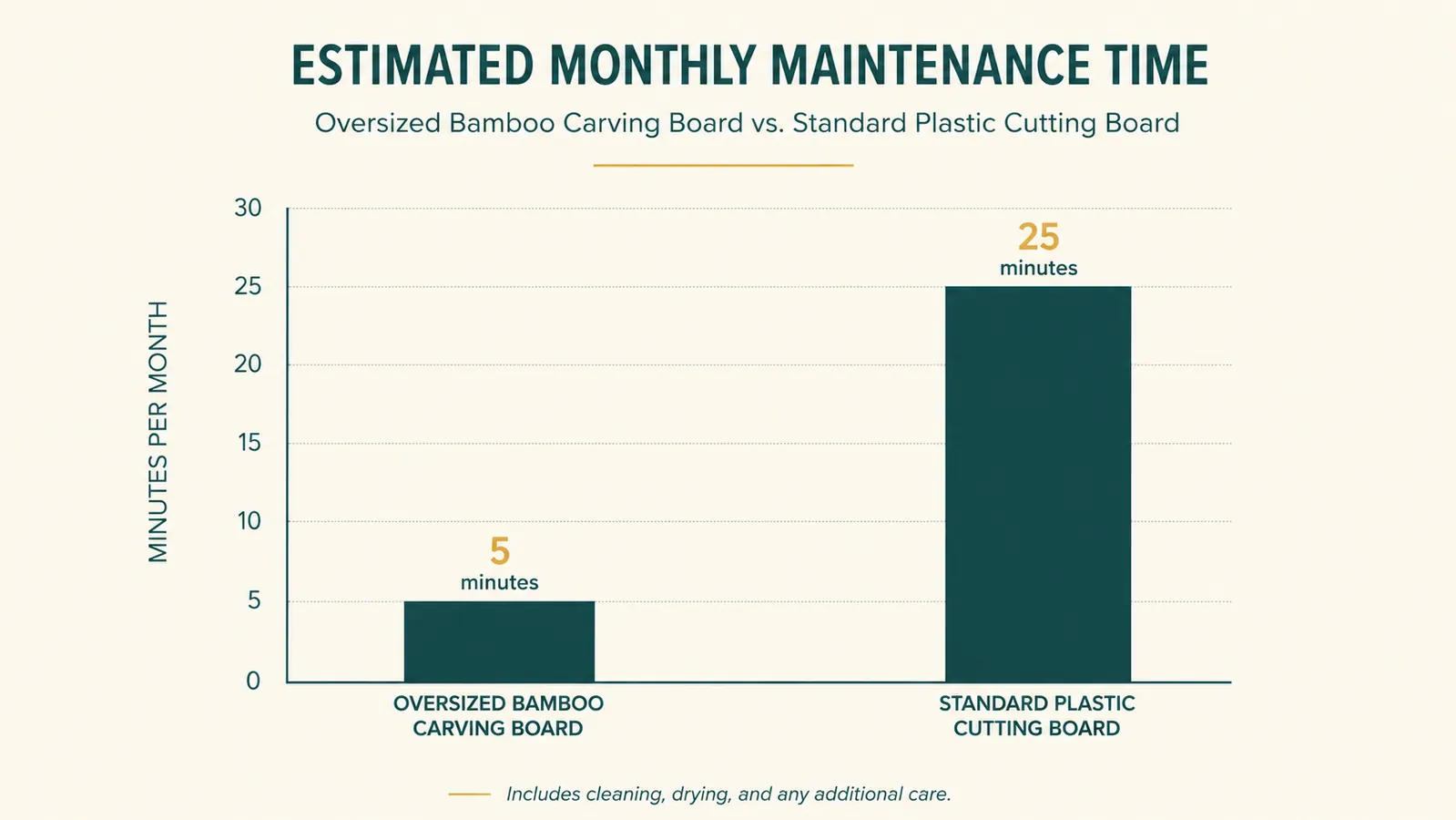
The part I wasn't prepared for is how each of those fifty uses comes with a tail on it. Carving a brisket takes fifteen minutes. Cleaning, drying and eventually oiling the Greener Chef board that carried it takes closer to twenty-five, spread across that evening and the next. Multiply that by fifty and you're looking at real hours over two years that a plastic board simply doesn't ask of you.
I've started keeping the board's routine on the same mental list as basting a brisket or checking the fire, which tells you something about how much it's become part of the actual cook rather than an afterthought. That's not a complaint exactly, it's just a fact nobody mentions until you're the one doing it every other Sunday for two years running.

The Maintenance Nobody Mentions in the Box
The instructions that shipped with the board mention oiling it periodically, in the vague way instructions always do. What they don't mention is that on the Gulf Coast, periodically means something closer to every ten days if you want the wood to actually stay tight. I've made it a standing Sunday evening habit now, ten to twelve minutes with a rag and food-safe mineral oil, done right after the board's dried from whatever it carved that day.
Ten to twelve minutes doesn't sound like much until you do the math on it. Sixty or seventy oiling sessions over two years works out to somewhere around twelve hours total, just standing at the counter rubbing oil into a cutting board. Nobody puts that number on the Amazon listing, and I understand why, since it would talk plenty of people out of buying it. I don't regret the time, but I went in thinking oiling was optional maintenance. On a board this size, in this climate, it isn't optional. It's the price of admission.
Marisol pointed out something I hadn't noticed myself: I've gotten better about it because the board is big enough that skipping the oiling actually shows, fast, as a dull, thirsty-looking patch near the center where the wood dries out first. A smaller board might hide neglect for a month. This one tells on me within a week.
The oil itself isn't expensive to keep stocked, and I don't mind the ritual once it became a habit instead of a chore I kept forgetting. What I'd tell anyone shopping for the Greener Chef board is to budget the time, not just the counter space, because the two matter about equally to whether you'll still like this board a year from now.
Washing Something That Doesn't Fit Any Sink in My House
Nobody mentions the sink problem before you buy. My kitchen sink is a standard double basin, and the Greener Chef board doesn't come close to fitting in either side, not laid flat, not tilted, not any way I've tried. So my actual washing routine happens at the hose bib on the back patio, board propped against the porch rail, a stiff brush, dish soap, and whatever the weather's doing that afternoon.
In August that's no hardship. In January, even here where winters stay mild, standing outside in the wind off the water scrubbing suds off a wet board at seven in the evening is not the relaxing part of hosting people, and it's not something a plastic board would ever ask of me. Marisol has taken to holding the far end steady while I scrub, which turned into its own small ritual, but it's a two-person job more often than the product page would ever admit.
On the rare rainy Sunday, I've propped it in the bathtub instead, which works but leaves a ring around the tub I have to scrub afterward, and Marisol has strong opinions about that. If your house doesn't have an outdoor hose bib within reach of the kitchen, or a tub you're willing to use for this, that's worth sitting with before you order a board this size. It genuinely does not fit a normal kitchen sink.
I've thought about buying a second, smaller wash basin just for this board, the kind you'd use for a turkey brine, and honestly that might be the fix if the hose bib routine ever wears thin. For now it hasn't, but it's the kind of workaround that tells you this board changes more about your kitchen routine than the listing lets on.
The Crack I Could Have Prevented
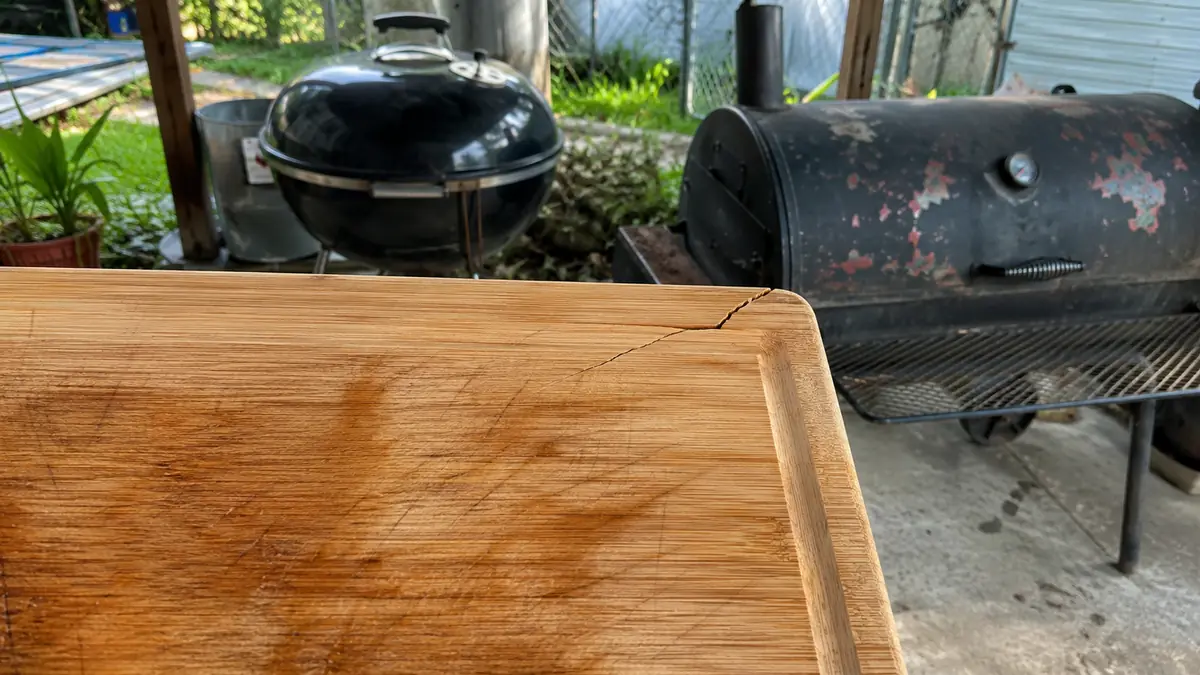
Early in my first spring owning the board, I found a hairline crack starting near one corner, close to the window where the kitchen gets the most afternoon heat. I've mentioned it before, but here's the part I usually leave out: it happened during a stretch when Marisol and I spent almost two weeks in Houston helping Kara after Ruben's tonsillectomy. The board sat in that humid gap by the fridge, un-oiled, for far longer than I'd normally let it go.
That's the mechanism nobody explains clearly enough. Bamboo dries out, contracts, and the stress shows up as a crack right where the wood is thinnest, usually a corner or an edge. It's not a manufacturing flaw in the Greener Chef board specifically, it's just what happens to wood when the oiling schedule gets interrupted for two or three weeks in a humid house. The crack hasn't spread since I got serious about the routine, but it's there permanently, a small reminder of exactly what happens when life gets in the way of a maintenance schedule.
If you travel often, or your household has stretches where nobody's home to keep an eye on a piece of wood this size, that's a real risk worth weighing before you buy. A plastic board would have sat in that same gap for two weeks and been perfectly fine when we got back. This one wasn't, and that's the honest tradeoff of the material, not a defect I'm blaming on the company.
What I do now, and what I told Hollis to do if he ends up buying one, is oil the board heavy the day before any trip longer than a few days, even if it's not due for its regular session yet. It's not a perfect fix, wood still moves with the air around it whether you're home or not, but it's cut down on how much I worry about the board while we're away.
Should You Just Buy Plastic Instead?
For a lot of households, yes, honestly. If you're not routinely carving something the size of a whole turkey or a full packer brisket, a plastic board will serve you better with none of what I've just described. It goes in the dishwasher, it doesn't crack from neglect, and it doesn't need a hose bib to get clean. I go through the tradeoffs in more detail in my wood versus plastic comparison, and I'd read that before you spend money on something this size if you're on the fence.
The Greener Chef board earns its keep in my kitchen specifically because I cook for a crowd most Sundays and the juice groove genuinely solves a problem plastic boards don't even attempt to solve. If that's not your reality, if you're mostly cooking for two or three people on weeknights, the size and the upkeep will feel like a chore you didn't sign up for rather than a feature you're glad you bought.
I'll say this plainly since most reviews won't: I don't think everyone reading this needs the Greener Chef board. Plenty of good cooks I know get by fine with a plastic board and never miss the juice groove or the extra surface area, because they're not carving whole birds or full packers on a weekly basis. Know which kitchen you're running before you order one this size.
What I Liked
- Big enough for a whole brisket or turkey with real room to spare
- The juice groove catches liquid a plastic board would just lose to the counter
- Forces good habits, since neglect shows up fast and gives you a chance to fix it
- Lifetime replacement policy backs up a purchase this size
- Held up structurally over close to two years of weekly use
Where It Falls Short
- Real maintenance cost, roughly ten to twelve hours of oiling a year on my schedule
- Doesn't fit a standard kitchen sink, washing means a hose bib or a bathtub
- Skipping oiling for even two or three weeks risks a permanent crack
- Too heavy and too large to be a casual, everyday cutting board
- Not a good fit for anyone who travels often or can't stick to a care routine
Nobody puts the oiling schedule and the hose bib on the product page. I'm putting it here, because that's the part that actually decides whether you'll love this board or resent it.
Who This Is For
If you already know you're the one carving whole turkeys and full briskets most weekends, and you're willing to treat oiling like a standing appointment rather than an afterthought, the Greener Chef board will do exactly what it promises. It's especially worth it if someone's usually around to help with the washing, since a two-person hose-down beats wrestling it alone. I get into the step-by-step of using it with a resting brisket in how to rest and carve a brisket the right way, if you want to see the routine in full.
It's also a good fit if you've read this far and none of what I've described sounds like a dealbreaker. Plenty of people will read the hose bib section and the crack section and still want this board, because the juice groove and the sheer size solve a real problem for them. I was one of those people, and I still am.
Who Should Skip It
If you travel often, live alone, or mostly cook smaller cuts on a weeknight rotation, this board is more commitment than reward. The oiling schedule doesn't pause for a work trip, the sink problem doesn't go away in a small apartment, and the crack risk is real if nobody's keeping an eye on it. I'd rather tell you that plainly than sell you a board that ends up sitting unused and cracking in a corner. My first, full story of buying and living with this board is over in the long-term Greener Chef review, and my story of why I finally pulled the trigger covers the decision itself, if you want more before you decide.
Still Sounds Like the Right Board for Your Kitchen?
If a crowd shows up at your table most weekends and you're willing to keep up the care routine, this is still the board I'd point you toward. Check today's price on Amazon and see if it's in stock.
Amazon Check Today's Price on Amazon →